Your data, analyzed by a team of AI agents.
Connect a CSV or database and watch specialized agents clean it, form hypotheses, debate them, and visualize what matters — then ask follow-ups in plain English on a live canvas.
A small pipeline today. A composable one tomorrow.
* on the roadmap · everything else is shipping in main
Not one model. A pipeline of specialists.
Most AI data tools throw your question at a single model. Insight Orchestra runs a pipeline of focused agents, each doing one job well — and each one shows its work.
Data Janitor
Cleans and profiles your dataset: types, duplicates, missing values, outliers, and bias flags.
Hypothesis Bot
Generates candidate insights and relationships worth investigating.
Debate Manager
Scores and debates the hypotheses, surfacing a confidence-ranked consensus.
Viz Whiz
Picks the right chart for each finding and renders it, with the code behind it.
Then it hands you a workspace — keep asking, and the canvas keeps answering.
Big charts. Real answers. Confidence scores.
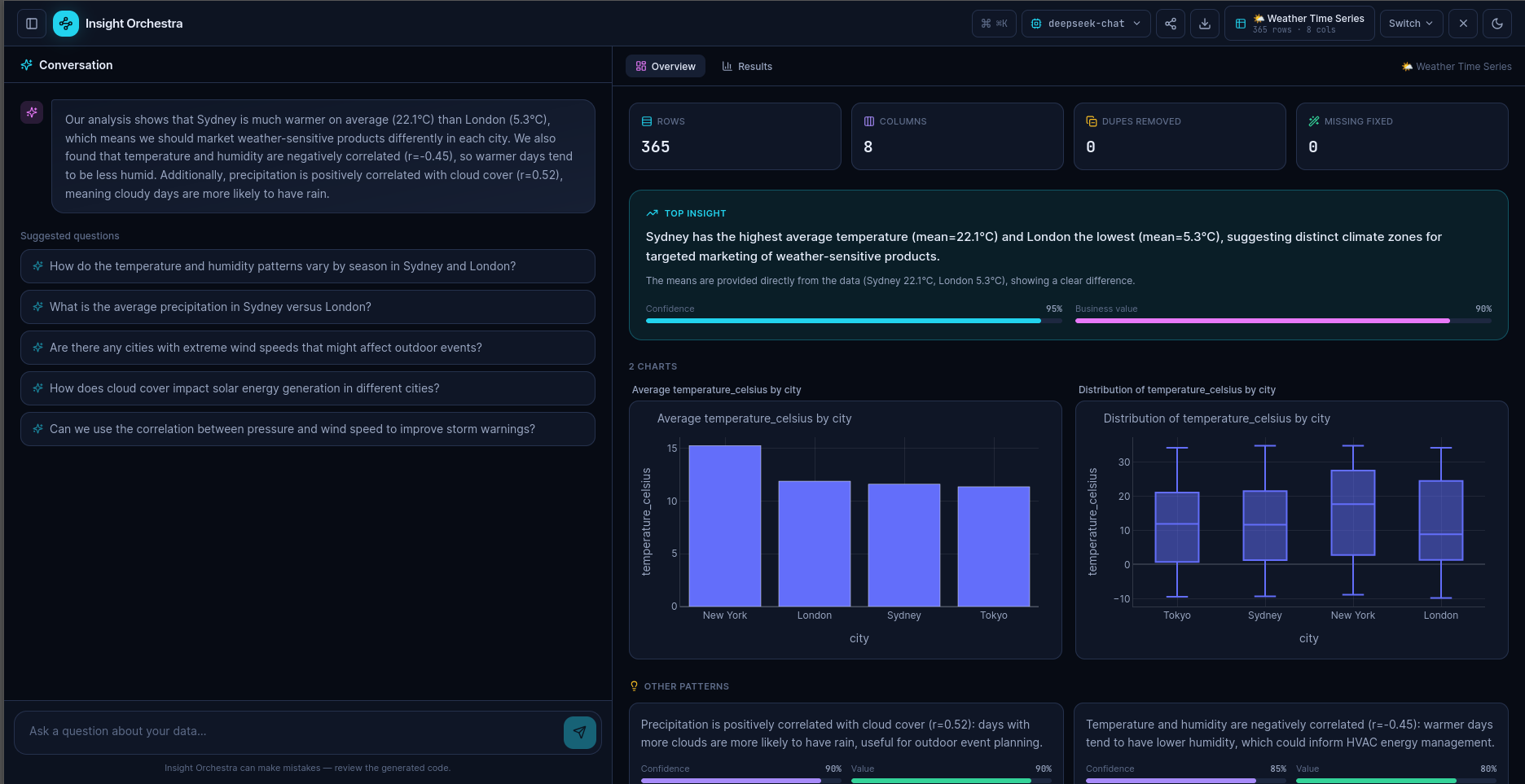
Every insight comes with the evidence behind it — a confidence bar, a business-value bar, the chart that proves it, and the Python that produced it. No black box.
- Top insight surfaced first, with the source numbers inline
- Overview and Results tabs — never cramped in a chat bubble
- Suggested follow-ups generated from what the agents found
- Switch models mid-conversation, with a live token + cost meter
A real analysis workspace, not a chat box.
Two-pane workspace
Conversation drives; a wide canvas visualizes. Ask on the left, watch charts build on the right.
Ask in plain English
NL → sandboxed Python → charts and answers.
Live, full-size charts
Results render big on the canvas — never cramped in a chat bubble.
Pin & compare
Side-by-side compare grids to weigh findings against each other.
Refine on the fly
"Bar chart, color by region, log scale" — iterate conversationally.
Streaming answers
Responses type out live with animated canvas transitions.
Bring your own model
Switch between OpenAI, Anthropic, DeepSeek, or local Ollama — with a live token + cost meter.
Connect anything
CSV upload, PostgreSQL, MySQL, SQLite, DuckDB, BigQuery, plus demo datasets.
Persistent history
Every analysis is saved — reopen, compare, or delete past runs.
Export & share
Interactive HTML, Markdown, CSV — or a read-only share link.
Command palette
⌘K to jump anywhere — keyboard-first.
Data preview
See a live sample of your cleaned data right in the canvas before you dig in.
Sandboxed execution
Generated code runs in RestrictedPython — safe by default, inspectable by you.
Built for people who'd rather ask than wrangle.
Felt like hiring a junior analyst that never sleeps — except it shows you the pandas it ran.
We replaced three hours of Monday-morning Excel with one paragraph and a chart.
Self-hosted in five minutes, pointed it at our warehouse, asked one question. Got an actual answer.
Open source, and proud of it.
Insight Orchestra is free to use, self-host, and extend. Star the repo to follow along — it genuinely helps, and it's how we know what to build next.
Up and running in two commands.
Self-host with Docker — your data and your model spend stay yours.
$ git clone https://github.com/laban254/insight-orchestra
$ cd insight-orchestra && docker-compose upYour data doesn't leave your environment.
Insight Orchestra runs locally via Docker. Use a local model (Ollama) for fully offline analysis, or plug in a hosted provider with your own key. Either way, you control where your data and your spend go.
Ask the questions you've been putting off.
"Which regions drive revenue, and what correlates with it?"
"What separates our top 25% of customers from the rest?"
"Flag outliers and data-quality issues before they skew reporting."
Built for trust and reproducibility.
Generated code runs in RestrictedPython — safe by default.
Inspect and copy the Python that produced each chart.
Each hypothesis comes ranked so you know where to look.
FastAPI · Next.js · Redis · Plotly · Docker Compose.
See your data think.
Star it, self-host it, and ask your first question in minutes.